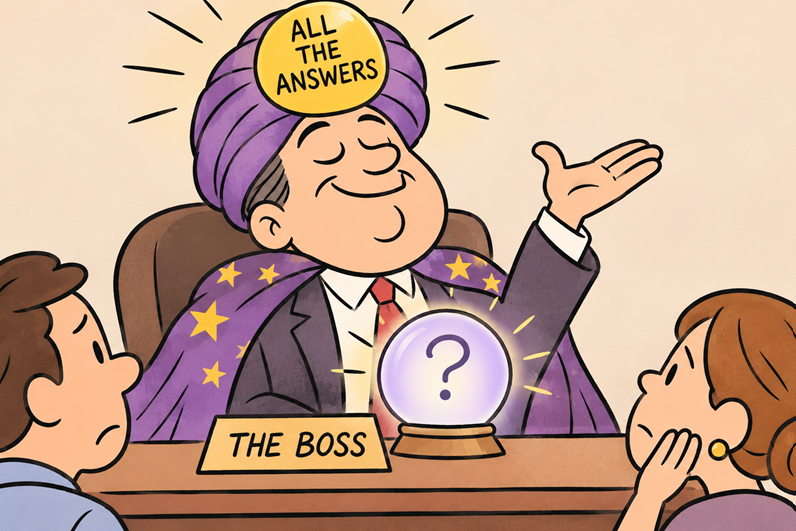
Years ago, I had a boss who always had all the answers.
Every time I made a mistake or wanted to explore options, he assumed this oracle-like posture and persona, ready to dispense his infallible wisdom to any unsuspecting victim nearby.
At first, I tried to be receptive, trusting that he was older and had more workplace experience. I listened and tried to ask thoughtful questions. But that only made things worse. The advice kept coming, like drinking from a fire hydrant.
Eventually, it became downright annoying, and I often left his advice sessions feeling incompetent, a little embarrassed, and unmotivated.
Over the years, I’ve come to believe that most of the time, people don’t really want advice, even when they ask for it. This includes your employees, your spouse, and even your kids.
Several well-established psychological principles help explain why advice can so often backfire.
Leaders are especially susceptible to this trap because of the power they hold over people’s paychecks and professional lives.
Over time, leaders in positions of power can begin to believe they have all the best answers. Inadvertently, they train their people to stop asking questions, proposing ideas, and innovating—the very behaviors necessary for a great team culture and a successful organization.
Let’s explore eight research-based reasons why leaders would be much better off giving less advice.
8 Research-Based Reasons Leaders Should Limit Advice
- It reduces autonomy.
Years ago, psychologists Edward Deci and Richard Ryan developed what became known as Self-Determination Theory, which emphasizes that people have a fundamental psychological need for autonomy and control over their own lives. Unsolicited advice can threaten this inherent need and leave people feeling controlled.
As a leader, you don’t want a team of people who won’t act without your input. It slows down operations and stifles initiative.
Instead, try asking this question first: “How would you approach this?”
- It limits critical thinking.
Research by Freeman and colleagues (2014) found that people learn more effectively through active engagement with problems than by passively receiving information. Ever met kids whose parents solve all their problems for them? They miss opportunities to develop the persistence and problem-solving skills that lead to great achievements.
Instead, try this: Ask employees what ideas they have, then encourage them to evaluate the pros and cons of each option.
- It weakens ownership.
A foundational principle of organizational development is that people are more likely to support an idea they helped generate.
One of the best ways to build motivation is to let your team develop solutions whenever possible. People are far more likely to take ownership of work when they’ve had a hand in shaping the solution. Constantly giving advice or telling people what to do can weaken that commitment.
Instead, try this: Tell employees what needs to be accomplished, then let them develop the action plans to achieve the goal whenever possible. Provide corrective feedback along the way and check in to make sure they’re on course.
- It undermines confidence.
Back in 1977, famed psychologist Albert Bandura introduced Self-Efficacy Theory, which emphasizes the importance of successful experiences in building confidence. People develop confidence in their abilities by tackling challenges and experiencing success.
Repeatedly supplying the answers as a leader can undermine this process.
Instead, try this: Let employees experiment with solutions and even make mistakes on low-risk tasks to develop confidence and problem-solving skills.
- It discourages creativity.
It seems obvious that supplying the solution diminishes the likelihood that your team members will come up with an even better idea. Yet leaders often struggle to resist the urge to jump in with answers.
If you want innovation, you have to create room for it.
Instead, try asking: “What else haven’t we tried?”
- It reduces psychological safety.
Psychologist Amy Edmondson is best known for her groundbreaking research on psychological safety, a vital component of organizational health and strong teams.
Remember my former boss? I often felt stupid after consulting with him, so eventually, I stopped asking for his input whenever possible.
When people fear feeling embarrassed, judged, or dismissed, they become less willing to speak up, ask questions, or share ideas.
Instead, try this: Listen with curiosity, resist the urge to immediately correct ideas, be attentive, and ask thoughtful follow-up questions. Avoid showing irritation or impatience. Team members thrive when leaders create a safe space to explore ideas.
- It generates defensiveness.
Psychological Reactance Theory, introduced in 1966 by psychologist Jack Brehm, suggests that people may resist advice when they perceive it as a threat to their freedom, even when the advice itself is helpful.
As a result, they may become defensive or resistant to your suggestions, regardless of how good those suggestions might be.
Instead, try this: If you need to give advice, ask permission first: “Would you like my perspective, or would you rather talk this through?” This simple approach can reduce defensiveness and preserve autonomy.
- It creates dependency on the leader.
The best organizations are full of people who can act independently, solve problems creatively, and make decisions without creating a bottleneck at the top.
Unfortunately, it’s remarkably easy to create an entire organization that becomes incapable of making decisions without you.
But what happens when you take a vacation or face a major medical issue? Does the entire organization grind to a halt because you’re not there to sign off on decisions?
That’s a huge problem.
Leadership expert John Maxwell suggests that one of the best tests of your leadership is how well your team functions when you’re out of the office.
How do you measure up?
Instead, try this: Have employees recommend solutions, be willing to let them try their ideas, listen before speaking, and ask thoughtful questions. Give them the freedom to make independent decisions, especially on low-risk tasks.
The Bottom Line
As you can see, most of these solutions begin with a coaching approach: asking thoughtful questions and encouraging team members to wrestle with problems so they can develop solutions and take greater ownership of their work.
It means becoming an expert sounding board, consultant, listener, and asker of challenging questions. It also requires the courage to allow people to make mistakes.
Ultimately, it involves letting go of perfectionism and the need for control, while recognizing that giving advice from a position of power is one of the easiest traps a leader can fall into.
Great leadership isn’t about having all the answers. It’s about developing people who don’t need you to provide them.
*By the way, this is also a great approach to start early with your kids if you want confident kids who can live independently and solve their own problems!
Have a great weekend!
Parker